
Engineering Excellence Together
At Apex Simultech Pvt. Ltd., we blend expertise in simulation and design to help you solve complex engineering challenges with precision and insight.


150+
15
Trusted Worldwide
10+ Years
Our Services
Apex Simultech tailored to your challenges
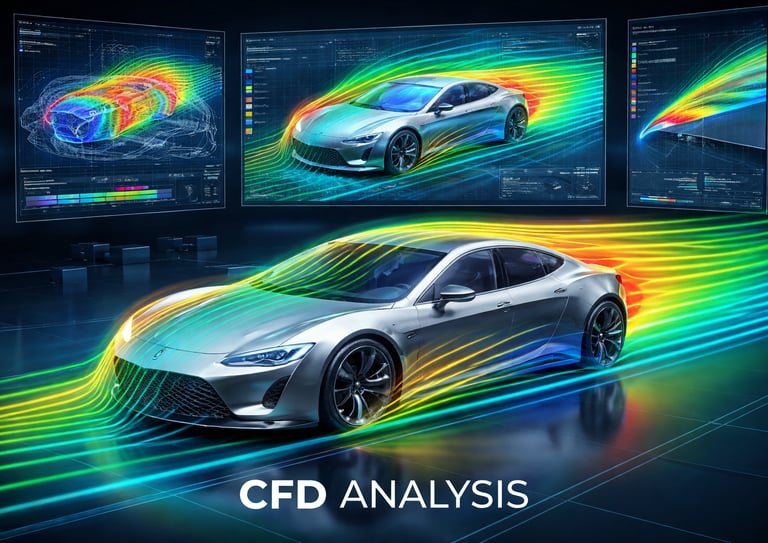
CFD Analysis
Computational Fluid Dynamics (CFD) Analysis is a remarkable engineering technique used to model the behavior and interaction of fluids (both liquids and gases) with surfaces through numerical methods and software.
What is CFD?
CFD encompasses the principles of:
> Fluid Mechanics
> Navier–Stokes equations
These equations articulate the relationships between the velocity, pressure, temperature, and density of a moving fluid.
How CFD Functions
Pre-processing
Create geometry (CAD model)
Mesh generation (divide the domain into smaller elements)
Solving
Apply boundary conditions (inlet, outlet, walls)
Solver calculates flow variables
Post-processing
Examine results using contours, vectors, and streamlines
FEA Services
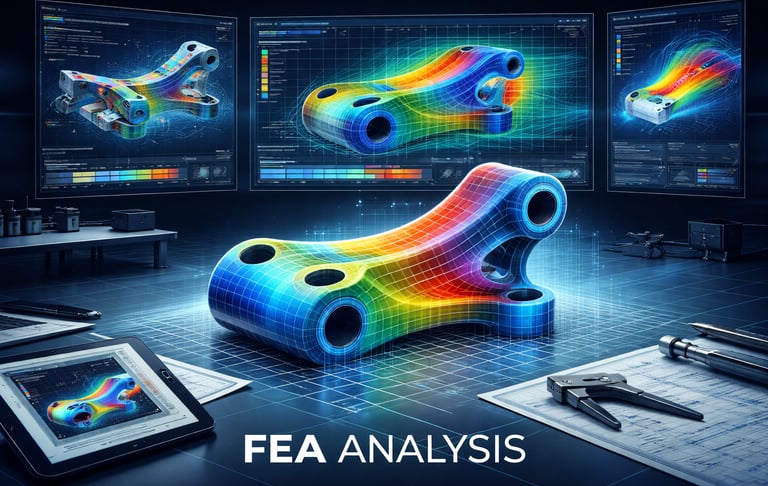
Finite Element Analysis (FEA) is an effective engineering simulation method utilized to forecast how a product or structure will perform under actual conditions such as forces, heat, vibration, and pressure.
What is FEA Analysis?
FEA breaks down a complex structure into small, manageable components known as elements. These elements are interconnected via nodes, creating a mesh. Mathematical equations are subsequently applied to estimate the behavior of each element, resulting in an overall prediction for the entire system.
How FEA Functions
Pre-processing
Develop geometry (CAD model)
Specify material properties
Apply loads and constraints
Create mesh
Solving
Software computes stresses, strains, displacements, etc.
Post-processing
Visualization of results (color contours, deformation plots)
Analysis of stress, temperature, etc.
Stay Updated
Get the latest simulation insights monthly